 LeafyOrb
Sudoku techniques · Fiendish level
XY-Wing: a pivot and two pincers
An XY-Wing is three cells with two candidates each. The pivot holds X and Y; it sees one pincer with X and Z, and another with Y and Z. Whichever digit the pivot takes, one pincer must be Z, so any cell that sees both pincers can lose Z.
How it works
Say the pivot can be 5 or 8. One pincer holds 8 or 9, the other 5 or 9. If the pivot is 8, the first pincer cannot be 8, so it is 9. If the pivot is 5, the second pincer is 9. You do not know which, but one of the two pincers is 9.
So a cell that sees both pincers cannot be 9: it would clash with whichever pincer turns out to be 9. The pincers do not need to see each other, only the pivot. It is the first move on the ladder that follows a chain of "if this, then that", and Ninebloom teaches it on Fiendish puzzles.
- The row, column or box the move uses
- The cells that make the pattern
- Candidates the move removes
- Links from the pivot to its pincers
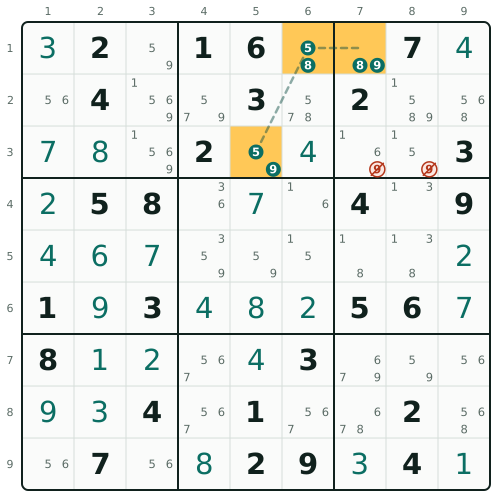
Example 1 · from Fiendish puzzle #912
The pivot R1C6 can only be 5 or 8. It sees R1C7 (8 or 9) and R3C5 (5 or 9). If R1C6 is 8, R1C7 must be 9; if it is 5, R3C5 must be 9. Either way one of the two pincers is 9, so a cell that sees both cannot be. Remove 9 from R3C7 and R3C8.
NG-1K4P5H-6GKQDD-HOGFSU-Y6KTQ5-R7BBY6-EF9U1H-Z8D2UD-B4O9GH-WB40T
Cells are named by row and column: R4C3 is row 4, column 3. Boxes are numbered 1 to 9, left to right and top to bottom.
How to spot it
- Fill in all pencil marks, then look only at cells with exactly two candidates.
- Pick one as the pivot, say XY. Among the two-candidate cells it sees, look for one with X and a new digit Z, and one with Y and the same Z.
- Find the cells that see both pincers. Often they are where a pincer's row meets the other pincer's box.
- Remove Z from those cells.
More examples
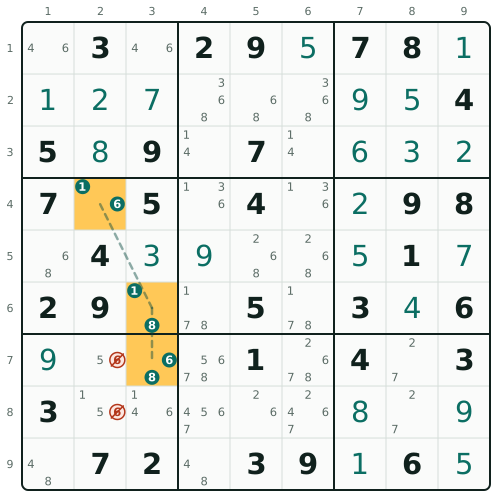
Example 2 · from Fiendish puzzle #655
The pivot R6C3 can only be 1 or 8. It sees R4C2 (1 or 6) and R7C3 (6 or 8). If R6C3 is 1, R4C2 must be 6; if it is 8, R7C3 must be 6. Either way one of the two pincers is 6, so a cell that sees both cannot be. Remove 6 from R7C2 and R8C2.
NG-17T0OF-8KARU6-G6VONV-IDBPB9-Q48U35-4NGUTM-WWUNTF-5914CO-CB3ZX
Common mistakes
- Using a pivot or pincer with three candidates. All three cells must have exactly two.
- Pincers that share both digits with the pivot. Each pincer shares one digit with the pivot, and the other must be the same Z in both.
- Removing Z from cells that see only one pincer. The cell must see both.
Questions
Why is it also called a Y-Wing?
It is the same pattern. Some books call it a Y-Wing; the name XY-Wing comes from the pivot's two digits, X and Y.
What is the difference between an XY-Wing and an XYZ-Wing?
In an XYZ-Wing the pivot also holds Z, so it has three candidates. That makes the pivot a third possible home for Z, so only cells that see all three cells lose it.
Which Ninebloom level uses the XY-Wing?
Fiendish. Fiendish puzzles need at least one move beyond the X-Wing, and the XY-Wing is one of them.