 LeafyOrb
Sudoku techniques · Fiendish level
Simple colouring: follow one digit in two colours
Simple colouring follows one digit through rows, columns and boxes where it has exactly two places. Colour those places alternately in two colours: one colour holds every copy of the digit. A cell that sees both colours cannot hold it, and a colour that sees itself is false.
How it works
When a digit has only two places in a row, column or box, exactly one of them is the digit. Call that a strong link. Links join up: if A and B are linked, and B and C, then A and C are the same, both the digit or both not. Colour the chain blue, orange, blue, and so on.
Either all the blue cells hold the digit, or all the orange ones do. That gives two rules. The trap: a cell outside the chain that sees a blue cell and an orange cell cannot hold the digit, whichever colour is right. The wrap: if two cells of the same colour share a row, column or box, that colour would place the digit twice, so it is false and the digit leaves all its cells.
- The row, column or box the move uses
- The cells that make the pattern
- Candidates the move removes
- The two colours of the chain
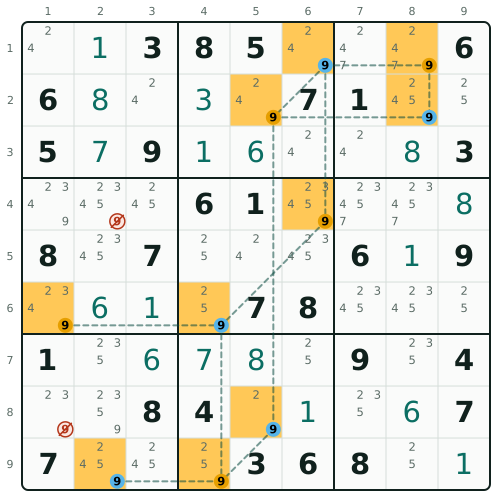
Example 1 · Colour trap · from Fiendish puzzle #684
Each linked pair is the only two places for 9 in a row, column or box, so exactly one of them is 9. Colour the chain alternately: blue R1C6, R2C8, R8C5, R6C4 and R9C2; orange R2C5, R1C8, R4C6, R9C4 and R6C1. Either every blue cell is 9 or every orange one is. R4C2 sees blue R9C2 and orange R4C6; R8C1 sees blue R8C5 and orange R6C1, so whichever colour is right, 9 is used up there. Remove 9 from R4C2 and R8C1.
NG-173UGN-4EX21H-X9YV8N-DIU02I-CHHTH6-Q8ZHLM-1JBAEF-5KPW49-LWWCH
Cells are named by row and column: R4C3 is row 4, column 3. Boxes are numbered 1 to 9, left to right and top to bottom.
How to spot it
- Fill in all pencil marks and pick one digit.
- Find the rows, columns and boxes where that digit has exactly two places.
- Start at one of those cells and colour it blue. Colour its partner orange, that cell's other partners blue, and keep going until the chain stops.
- Look for a cell outside the chain that sees both colours (a trap), or two cells of one colour in the same unit (a wrap).
More examples
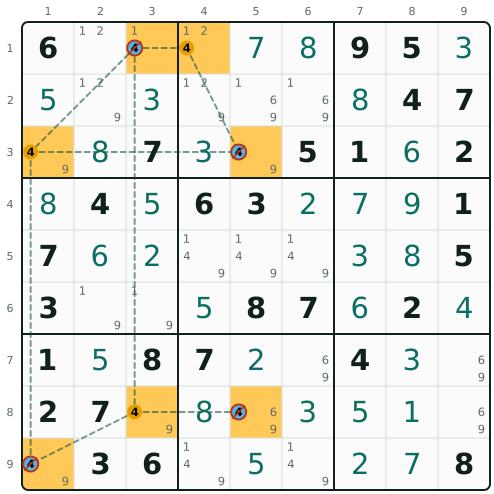
Example 2 · Colour wrap · from Fiendish puzzle #626
Each linked pair is the only two places for 4 in a row, column or box, so exactly one of them is 4. Colour the chain alternately: blue R1C3, R3C5, R9C1 and R8C5; orange R3C1, R1C4 and R8C3. Either every blue cell is 4 or every orange one is. But R3C5 and R8C5 are both blue and share column 5, which cannot hold two 4s. So blue is false. Remove 4 from R1C3, R3C5, R9C1 and R8C5.
NG-1W15LM-TUEZD1-KI07XD-M545BS-2F0LDP-UBUTKX-CAGW15-8WY75D-KHVFQ
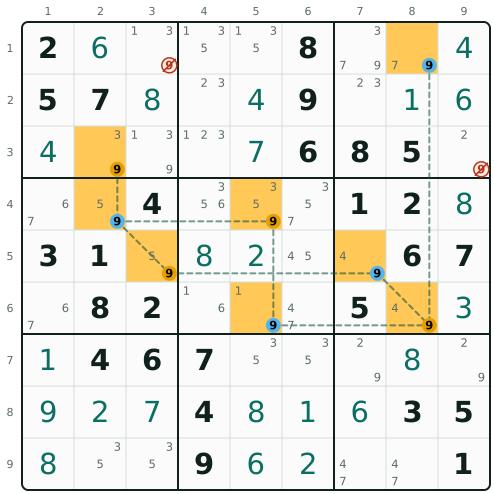
Example 3 · Colour trap · from Fiendish puzzle #604
Each linked pair is the only two places for 9 in a row, column or box, so exactly one of them is 9. Colour the chain alternately: blue R4C2, R5C7, R6C5 and R1C8; orange R5C3, R4C5, R3C2 and R6C8. Either every blue cell is 9 or every orange one is. R1C3 sees blue R1C8 and orange R5C3; R3C9 sees blue R1C8 and orange R3C2, so whichever colour is right, 9 is used up there. Remove 9 from R1C3 and R3C9.
NG-1HKMKQ-59HVBG-ZBWITR-12QPZ6-QFV406-8H6F8X-95X16V-WANRZU-GTNF5
Common mistakes
- Linking cells in a unit where the digit has three places. Only units with exactly two places make a link.
- Mixing two separate chains. Colours only mean something within one connected chain.
- Removing the digit from cells that see only one colour. They need to see both.
Questions
What is the difference between the colour trap and the colour wrap?
A trap removes the digit from a cell outside the chain that sees both colours. A wrap finds a colour that sees itself, so every cell of that colour loses the digit and the other colour is all true.
How is simple colouring related to the X-Wing?
Both work with one digit at a time. An X-Wing looks at two lines; simple colouring follows a chain of pairs as far as it goes, so it can reach cells a fish cannot.
Which Ninebloom level uses simple colouring?
Fiendish. The hint highlights the whole chain and says which of the two rules it used.