 LeafyOrb
Sudoku techniques · Medium level
Pointing pairs: when a box points down a line
A pointing pair happens when a digit's only places in a box all lie in one row or column. The box must use that line for the digit, so the digit cannot go anywhere else on that line, outside the box.
How it works
Take box 3 and the digit 4. If the only cells in box 3 that can hold a 4 are both in row 3, then the 4 for box 3 is in row 3. Row 3 can only have one 4, so the rest of row 3 cannot have it.
The same works with three cells in a line (a pointing triple), and with columns as well as rows. Its mirror image is box/line reduction, which starts from the line instead of the box.
- The row, column or box the move uses
- The cells that make the pattern
- Candidates the move removes
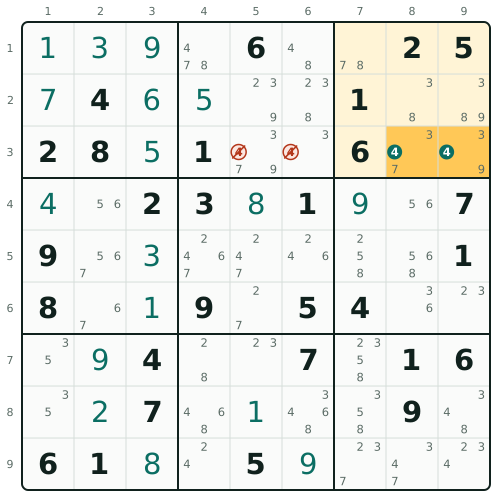
Example 1 · Row · from Medium puzzle #658
In box 3, the 4 can only go in R3C8 and R3C9, and they all sit in row 3. Whichever one gets it, the 4 for row 3 is inside box 3. Remove 4 from R3C5 and R3C6.
NG-1CFHY0-ZOSTIE-XGVRW1-1HDOCO-A260I9-4RCHHA-YZK5CG-W5UWMO-CGEEW
Cells are named by row and column: R4C3 is row 4, column 3. Boxes are numbered 1 to 9, left to right and top to bottom.
How to spot it
- Pick a box and a digit it still needs.
- Mark every cell in the box where that digit could go.
- If those cells all sit in one row or column, the digit "points" along it.
- Remove that digit from the rest of the row or column, outside the box.
More examples
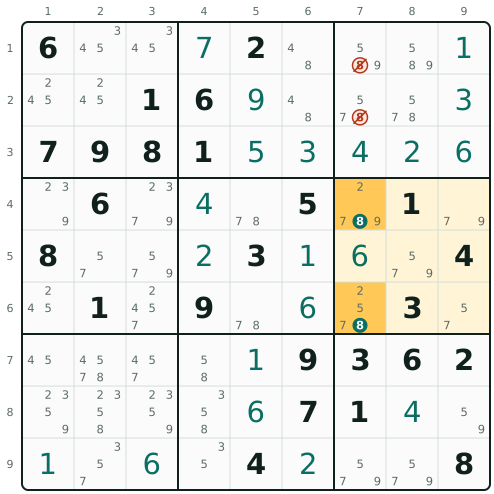
Example 2 · Column · from Medium puzzle #101
In box 6, the 8 can only go in R4C7 and R6C7, and they all sit in column 7. Whichever one gets it, the 8 for column 7 is inside box 6. Remove 8 from R1C7 and R2C7.
NG-1W24XA-I0XS6B-6KBFEM-YORFBF-RQUF4C-QYARRI-LU23JF-UUKWE0-WYQHK
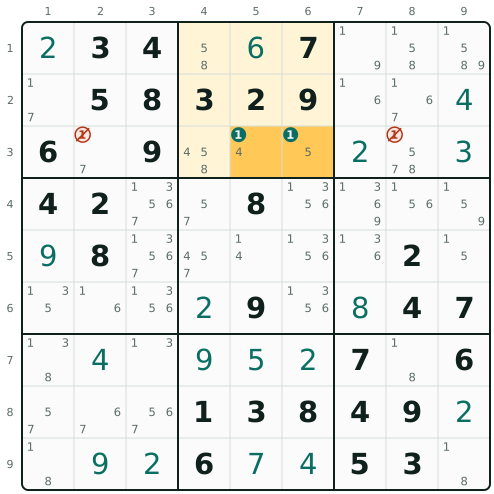
Example 3 · Row · from Medium puzzle #951
In box 2, the 1 can only go in R3C5 and R3C6, and they all sit in row 3. Whichever one gets it, the 1 for row 3 is inside box 2. Remove 1 from R3C2 and R3C8.
NG-1GGX53-2GLK12-GQYM2D-KAKY2Q-RFEKWK-J13NS3-UHXAXQ-U6N03V-RFC2Q
Common mistakes
- Removing the digit inside the box. The elimination is on the line, outside the box.
- Counting a box where the candidates are in two rows. All of them must be on one line.
- Confusing it with box/line reduction. Pointing starts from the box; box/line starts from the row or column.
Questions
What is the difference between a pointing pair and box/line reduction?
A pointing pair starts in a box: the digit's spots in the box line up, so the line loses it outside the box. Box/line reduction starts in a row or column: the digit's spots on the line are all in one box, so the box loses it off the line.
Does a pointing pair have to be two cells?
No. Two or three cells in one row or column of the box work the same way. Three is often called a pointing triple.
Which Ninebloom level uses pointing pairs?
Medium, together with naked pairs.